
Forward Head Posture Correction: A Gentle Approach to Lasting Structural Harmony

Did you know that recent research indicates over 80% of young adults now present with postural distortion patterns? In my 23 years of clinical practice, I often notice a common pattern where the body seems to brace against daily stressors, leading many to seek effective forward head posture correction. You might feel as though your head is becoming a heavy weight for your shoulders to carry, or perhaps you're struggling with that persistent "stuck" feeling in your upper back. It's a tiring burden to manage, especially when it results in frequent tension headaches or a sense of mental fog that just won't lift.
We understand how frustrating it is to feel like your body is working against you. This article aims to show you how a gentle, nervous-system-led approach may support your journey toward lasting structural harmony and restored vitality. We'll explore why your posture changed in response to life's demands and how nurturing your internal systems can lead to improved energy, reduced discomfort, and a more confident, upright presence.
Table of Contents
Understanding Forward Head Posture: Why Your Nervous System Holds the Key
When we discuss Understanding Forward Head Posture, we are looking at a specific alignment where the head sits anteriorly, or forward, relative to the shoulders. It is a common sight in our tech-heavy world, but it is much more than just a "bad habit" or poor ergonomics. Over my 23 years in practice, I've seen how this pattern often begins as a subtle shift before becoming a deeply ingrained structural habit.
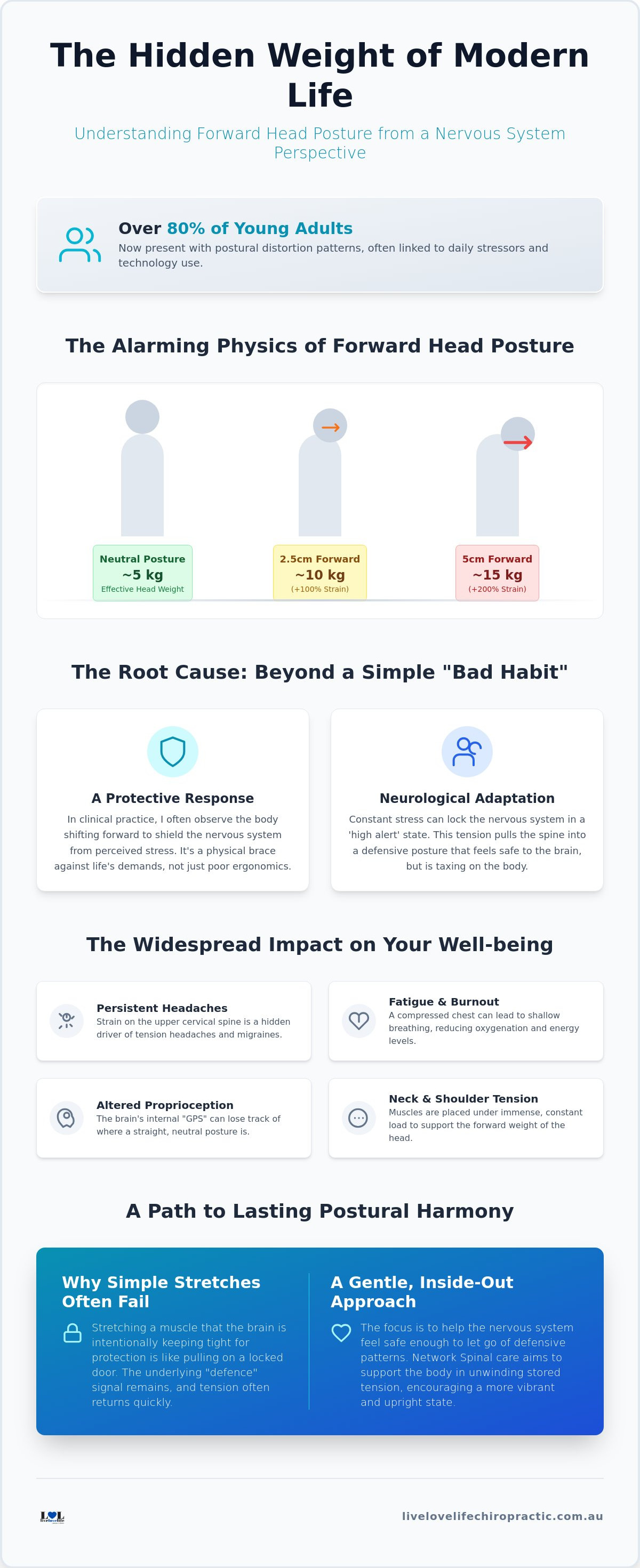
In clinical practice, I often notice the body shifts into this position as a way to shield the nervous system from perceived stress. I refer to this as a "Protective Response." It's as if the spine physically curls forward to protect the vital structures within when life feels overwhelming. This shift means that forward head posture correction is about much more than just "sitting up straight"; it's about helping the nervous system feel safe enough to let go of that protective bracing.
Physics also plays a significant role in how you feel. For every 2.5 centimetres your head moves forward from its ideal centre, the effective weight on your cervical spine increases by approximately 4.5 to 5.5 kilograms. This constant strain can lead to significant discomfort as your muscles and joints work overtime just to keep you upright. Ultimately, forward head posture is a neurological adaptation to modern environmental stressors, reflecting how our internal systems try to cope with the world around us.
The Hidden Link Between Stress and Spinal Tension
When you're under chronic stress, your nervous system can stay in a "high alert" state. This keeps the spinal cord and surrounding tissues under constant tension, pulling the vertebrae into a defensive posture that feels safe to the brain but taxing to the body. One pattern I often notice is that this tension becomes so familiar that the body forgets how to exist without it.
Over time, this affects your proprioception, which is your brain's internal map of where your body is in space. Many people we see in Woollahra and the surrounding Eastern Suburbs find that their brain has actually lost track of where "straight" is, making a hunched position feel like the new normal. It's not that the body is broken; it's simply that the internal GPS needs a gentle recalibration.
Our approach focuses on helping you reset this internal tension from the inside out. By using Network Spinal Care, we aim to support your nervous system in releasing these defensive patterns. This gentle method allows your body to find its way back to a more balanced, energetic, and vibrant state of being without the need for forceful manipulation.
The Wider Impact: From Tension Headaches to Cognitive Vitality
Forward head posture doesn't just affect how you look; it fundamentally changes how you feel throughout the day. When the head drifts forward, it places an immense, constant load on the trapezius and levator scapulae muscles. This often manifests as chronic neck and shoulder tension that feels impossible to shake, no matter how many times you try to roll your shoulders. In clinical practice, I've observed that this constant muscular strain is frequently the hidden driver behind persistent headaches or migraines, as the upper cervical spine struggles to manage the structural imbalance.
One pattern I often notice in Woollahra professionals is the strong correlation between this postural shift and feelings of fatigue or burnout. When your body is stuck in a protective hunch, it can actually compress the chest cavity. This leads to shallower breathing and reduced oxygenation, which may contribute to that afternoon brain fog many of us know all too well. It's a cycle where physical tension drains your cognitive vitality, leaving you feeling depleted before the workday is even done.
Why Simple Stretches Often Fail to Create Lasting Change
Many people try to find relief through basic stretching or foam rolling. While these can feel good in the moment, they often fail to provide a long-term solution for forward head posture correction. If your brain is intentionally keeping a muscle tight to protect your spinal cord from perceived stress, stretching that muscle is like pulling on a locked door. The tension usually returns within hours because the underlying "defence" signal hasn't been addressed. This is why we prioritise a neurostructural examination to understand the root cause rather than just chasing the symptoms.
While some research on corrective exercises suggests they can support recovery, forcing the body into alignment through aggressive cracking or restrictive braces often bypasses the nervous system's need for safety. True harmony comes when the system learns to let go of its own accord. If you've felt "stuck" in these patterns for years, it might be time to explore a gentler path toward lasting structural ease and energy.
A Gentle Path to Postural Harmony in Sydney’s Eastern Suburbs
At Livelovelife Chiropractic, we view the body as a self-organising system with immense untapped potential. Our approach to forward head posture correction centres on gentle spinal entrainments. These are precise, light touches designed to help the nervous system "unwind" stored tension from the inside out. Rather than using forceful manipulation, Network Spinal care aims to support your body’s natural ability to self-correct and find its own way back to balance.
In clinical practice, I've developed a three-step framework tailored for our busy Eastern Suburbs community. First is the Assessment, where we identify the neurostructural patterns keeping you "stuck." Next is Awareness, where you learn to recognise the subtle internal cues of tension. Finally, through Entrainment, we help your system release defensive bracing. We invite you to view this as a journey toward overall wellness rather than a temporary fix for a physical symptom.
Practical Lifestyle Shifts for Woollahra Professionals
For those of us managing home offices in Paddington or Double Bay, ergonomics play a supportive role. Position your monitors at eye level to prevent the head from drifting forward, and incorporate frequent "micro-breaks" to reset your nervous system. One pattern I often notice is how easily we carry work stress into our personal time. Try performing a mindful "spinal check" during your commute on the T4 line or while enjoying a weekend walk in Centennial Park to see if you can soften your shoulders and deepen your breath.
True structural harmony is a positive lifestyle choice that supports every aspect of your life. If you feel ready to move away from chronic tension and toward a more vibrant future, we invite you to book an initial consultation for a personalised posture assessment. It's a gentle first step toward understanding your body's unique needs and restoring your natural vitality.
Embracing a Future of Structural Ease and Vitality
Your journey toward a more balanced and energetic life begins with understanding that your body is a brilliant, self-regulating system. We've explored how a forward-leaning posture is often a protective response to life's stressors, and how true forward head posture correction involves more than just physical stretches. By addressing the underlying signals within your nervous system, you can help your body release long-held tension and rediscover its natural, upright rhythm.
With 23 years of clinical experience, I've seen how our gentle, non-invasive Network Spinal approach supports families across Sydney in finding lasting structural harmony. We focus on creating personalised wellness plans that respect your body's unique pace and potential. It's about moving toward peak capacity, where energy flows freely and physical discomfort no longer dictates your day.
If you're ready to explore how a calmer nervous system can lead to a more vibrant you, we're here to guide you. You can Book Your Initial Neurostructural Examination in Woollahra today. Let's work together to help your body feel like the safe, energetic home it was always meant to be.
Frequently Asked Questions
Can forward head posture be corrected after years of poor habits?
Yes, the body maintains an incredible capacity for change at any age because the nervous system is constantly adapting to new information. One pattern I often notice in my 23 years of practice is that even long-standing habits can shift when we address the underlying "defence" signals in the spine. While ingrained patterns may take time to unwind, our approach focuses on retraining the brain's internal map, which aims to support lasting forward head posture correction regardless of how long you've felt stuck.
How is Network Spinal different from traditional chiropractic adjustments for posture?
Network Spinal care differs from traditional methods by focusing on gentle, precise touches rather than forceful manual manipulation. Instead of "cracking" the spine into a new position, we use light contacts at specific points to help the nervous system recognise and release its own stored tension. This process encourages the body to self-correct from the inside out, making the experience feel like a supportive partnership in health rather than a mechanical repair of a broken machine.
Will I need to do exercises at home to see results?
You don't necessarily need a complex home exercise regime to see progress with our care. While we may suggest mindful lifestyle shifts, such as ergonomic adjustments for your Woollahra home office, our primary goal is to change the neurological signal that keeps your muscles tight in the first place. Once your nervous system feels safe enough to let go of its defensive bracing, many people find that maintaining a more upright and vibrant posture happens naturally without the need for constant, forced effort.
How long does it typically take to notice a change in my posture?
Every individual's journey is unique, but many people report feeling a greater sense of ease and relaxation after their very first session. Significant structural shifts usually happen gradually as the body learns to sustain its new, more balanced state. In my experience working with busy Sydney families, most individuals start to observe a visible difference in their forward head posture correction and daily energy levels within the first few weeks of consistent care as their internal systems stabilise.


Comments